
Portable Changeable Message Sign (PCMS) Battery Options:
- Wet Lead-acid (FLA – stands for Flooded Lead-Acid)
- Sealed Lead-acid (SLA)
- Lithium Iron Phosphate (LiFePO4)
Wet lead-acid batteries:
The battery is like the battery in your car. Some PCMS manufacturers are moving away from this battery to the Sealed Lead-Acid battery. Many Traffic Control companies are replacing these batteries with Sealed Lead Acid batteries as they fail in the field.
Pros:
- Cost – Initially Less expensive.
- High Surge Current – Capable of delivering high surge currents like starting engines.
Cons:
- Cost – Long term more expensive than any other option
- Maintenance: Requires regular maintenance (watering), including systematic checking and refilling of the electrolyte levels.
- Weight and Size: Heavier and much bulkier.
- Shorter Lifespan: Shorter lifespan (1 ½ to 3 years).
- Theft – Prized option for thieves, especially for producing meth production.
Sealed lead-acid batteries:
A sealed lead-acid (SLA) consists of lead plates and an electrolyte, but unlike wet lead-acid batteries, the electrolyte is immobilized, either in a GEL form or absorbed in a glass mat (AGM).
Pros:
- Cost –Maintenance-Free
- Maintenance: Spill-Proof
- Durability – more resistant to vibration compared to wet lead-acid batteries.
Cons:
- Cost – Initially more expensive than wet lead-acid batteries. Long term cost is lower.
- Limited Lifespan – Shorter lifespan (3 to 5 years) since typical lifespan is 300-500 cycles.
- Weight – Medium heavy and bulky.
- Temperature – High temperatures accelerate aging. Low temperatures reduce capacity.
- Theft – Prized option for thieves, especially for its lead content for resale.
LiFePO4 (Lithium Iron Phosphate) batteries:
A LiFePO4 (Lithium Iron Phosphate) battery consists of a lithium iron phosphate cathode, a graphite anode, and an electrolyte that facilitates the movement of lithium ions between the electrodes.
Pros:
- Cost –Maintenance-Free
Even though the current acquisition cost of a LiFePO4 battery is higher than a sealed lead-acid battery, its Life Cycle Cost is dramatically lower.
- You will replace a lead-acid battery two or three times compared to one LiFePo4 battery.
- Maintenance free, a LiFePO4 will drop your maintenance costs.
- Long Lifespan – More charge and discharge cycles, often exceeding 4000 cycles, which translates to a lifespan between six and eleven years. LiFePO4 batteries typically last 5-10 times longer than lead-acid batteries (typical 300-500 cycles for lead-acid).
- Stable Voltage – These batteries maintain a consistent voltage throughout the discharge cycle, providing reliable power. This stable voltage lengthens the lifespan of your electronic equipment and minimizes the failure rate of the sign controller and the LEDs themselves.
Depth of Discharge:
LiFePO4 batteries can be discharged up to 80-90% of their capacity without damaging the battery, while lead-acid batteries should not be discharged beyond 50% to avoid reducing their lifespan. This key point is amplified in northern climates or long stretches minimal solar panel charging. In fact, sealed lead-acid should not be discharged beyond 50% of their capacity to avoid significantly reducing their lifespan, limiting their usable capacity.
Efficiency:
LiFePO4 batteries have less energy lost during charging and discharging than SLA. They can achieve up to 95% efficiency compared to around 70-80% for lead-acid batteries.
- Safety – This type of battery is known for its safety, stability, and long cycle life. This is NOT a Lithium-Ion battery.
- Weight – They are significantly lighter, often weighing about one-third of a comparable lead-acid battery.
- Fast Charging – Charged quickly, often reaching full charge within a brief period.
- Performance in Extreme Temperatures – Performs well in very hot temperatures.
- Environmental Impact – They are considered more environmentally friendly as they do not contain cobalt, which is toxic and difficult to mine. LiFePO4 batteries are more environmentally friendly as they do not contain toxic lead or acid and have a longer charging.
Cons:
- Cost – Higher initial cost.
- Performance in Extreme Temperatures – Poor performance in very cold temperatures.
- Theft – Less targeted by thieves over lead-acid batteries but have resale value.
Battery Choice:
Clearly the winner is the Lithium Iron Phosphate (LiFePO4) battery. We have provided some additional information below if you are interested.
LiFePO4 vs Sealed Lead Acid Maintenance:
- These batteries require no maintenance.
- Storage: LiFePO4 batteries typically do not need a trickle charge. Many customers will maintain a lead acid battery in storage with a trickle charger to continuously keep the battery at 100% so that the battery life does not decrease. This requirement is because the self-discharge rate of an SLA battery is 5 times or greater than that of a lithium battery.
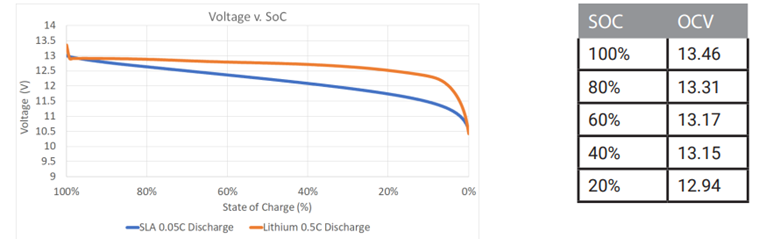
LiFePO4 vs Sealed Lead Acid Charge Time:
- Low charged lead-acid batteries take nearly eight (8) hours to fully charge. Power source (solar panels or external powered trickle chargers) make no difference.
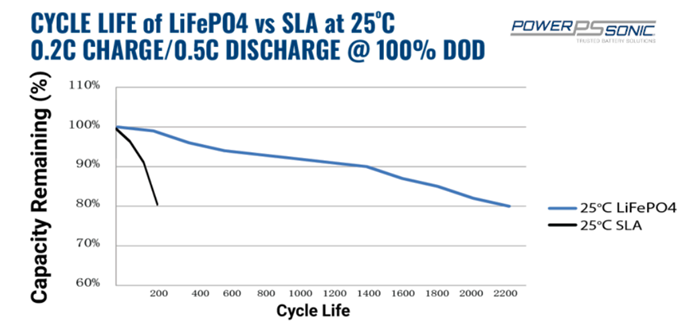
Courtesy of PowerSonic
- Charging SLA batteries is notoriously slow. In standby applications, an SLA battery must be kept on a float charge. With lithium batteries, charging is four times faster than SLA. The faster charging means there is more time the battery is in use, and therefore requires less batteries. They also recover quickly after an event (like in a backup or standby application). As a bonus, there is no need to keep lithium on a float charge for storage.
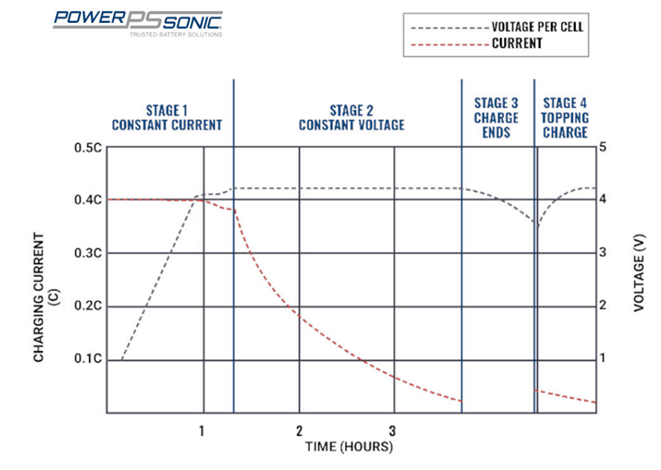
Courtesy of PowerSonic
- Stage 2 is necessary in both chemistries to bring the battery to 100% SoC. The SLA battery takes 7 hours to complete Stage 2, whereas the lithium battery can take as little as 15 minutes. Overall, the lithium battery charges in four hours, and the SLA battery typically takes 10. In cyclic applications, the charge time is critical. A lithium battery can be charged and discharged several times a day, whereas a lead acid battery can only be fully cycled once a day. Where they become different in charging profiles is Stage 3. A lithium battery does not need a float charge like lead acid. In long-term storage applications, a lithium battery should not be stored at 100% SoC, and therefore can be maintained with a full cycle (charged and discharged) once every 6 – 12 months to 30% – 70% SoC. In standby applications, since the self-discharge rate of lithium is so low, the lithium battery will deliver close to full capacity even if it has not been charged for 6 – 12 months.
Temperature Impact on LiFePO4 vs Sealed Lead Acid Battery
HIGH TEMPERATURE
- Lithium’s performance is far superior to SLA in high temperature applications. In fact, lithium at 55°C still has twice the cycle life as SLA does at room temperature. Lithium will outperform lead under most conditions but is especially strong at elevated temperatures.
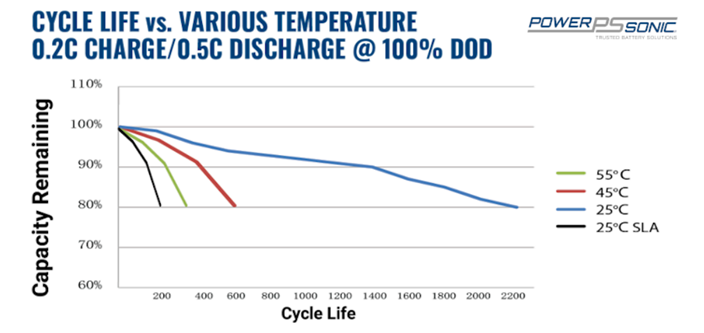
Courtesy of PowerSonic
COLD TEMPERATURE
- Cold temperatures cause significant capacity reduction for all battery chemistries. Two key factors to consider when evaluating a battery for cold temperature use: charging and discharging.
- A lithium battery will not accept a charge if the battery itself is at a low temperature (below 32° F). However, an SLA can accept low current charges at a low temperature.
- A lithium battery has a higher discharge capacity at cold temperatures than SLA. This means that lithium batteries do not have to be over designed for cold temperatures, but charging could be a limiting factor. At 0°F, lithium is discharged at 70% of its rated capacity, but SLA is at 45%.
Battery Management System (BMS)
- The correct Battery Management System (BMS) controller is key to extending the life of your LiFePO4, especially in the field so that you spend less time and travel maintaining batteries.
- Charging Management- The solar panels must not be allowed to charge the batteries when the sun is available if the battery temperature is below 0 degrees C (32 degrees F). The BMS should have the capability to detect battery temperature.